


#3 Notebook - The creative process in glass

Updated: Aug 10

Every glasswork begins with an idea.
But an idea alone is never enough.
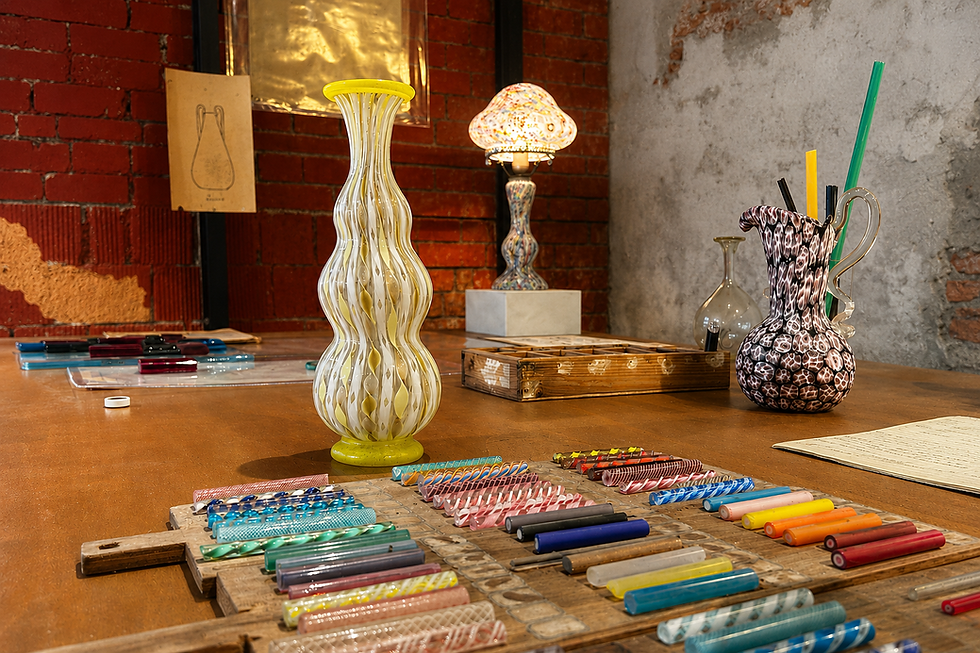
A first sketch captures a concept. Technical drawings define proportions, dimensions and production details. From there, the design enters a process of experimentation, where imagination meets the possibilities—and the limitations—of glass. Glass demands that ideas are constantly tested against the material itself.
Colours are tested, adjusted and combined.
Murrine became one of Fratelli Toso's most important fields of experimentation. Rather than repeating established patterns, new murrine and decorative canes were continuously developed, refined and combined to create entirely new decorative languages.
From traditional millefiori to increasingly geometric and technically complex designs, murrine evolved continuously, opening new decorative possibilities. The development of a new murrina did not end with the murrina itself. It became the foundation for entire families of objects, from everyday tableware, drinking glasses and ashtrays to lamps, chandeliers and unique artistic vases, demonstrating how a single decorative element could generate countless creative possibilities.
Glassmaking techniques also evolved continuously to achieve new visual effects. Forms developed through prototypes, variations in scale and proportion, and repeated trials that gradually transformed an initial concept into a finished object.
Innovation rarely comes through a single breakthrough. It is the result of countless small decisions. It grows from continuous observation, testing and refinement. Every new object balances artistic ambition, craftsmanship and production.
New ideas must achieve the desired visual result while remaining technically feasible, economically sustainable and suited to an ever-changing market.
Design also evolves in dialogue with its time. Artistic movements, architecture, fashion, collectors, clients and even competing manufacturers all contribute to shaping new ideas. Personal interests become part of this process as well. Ermanno Toso's fascination with Japanese art inspired the Kiku murrina series, while Pollio Perelda's background as a painter influenced his approach to colour, composition and form.
Alongside experimentation, every Murano glassworks also relied on serial production for the wider market. These collections provided the economic foundation that allowed research and innovation to continue. Experimentation and production were never separate worlds: each sustained the other.
The Fratelli Toso Archive preserves every stage of this journey, revealing that every finished glasswork is not the beginning of the story, but its final chapter.
Batch books, colour recipes and compositions | Libri delle partite, ricette e composizioni dei color From initial drafts to colour studies, defining size and proportion | Bozzetti, colori, definizione Photographic archive, objects | Archivio fotografico oggetti Vaso Kiku, Ermanno Toso


Comments